Forty-five percent of the English speeches at the 2026 UN General Assembly used the word profound. Before ChatGPT, about one speech in six did. We went back to the podium right after the 81st General Debate closed and counted the same eleven ceremonial words that AI chatbots overuse in 1,061 English statements from 2015 to 2026. The register peaked in 2025 at 12.8 uses per 10,000 words, eased to 9.1 in 2026, and is still about 50% above where it stood before 2023. The vocabulary did not simply fade. It rotated.
Did AI Words Decline at the UN General Assembly in 2026?
Yes, from their 2025 peak, but they did not return to their old level. The eleven words fell from 12.76 to 9.08 per 10,000 words between the 2025 and 2026 debates, while the pre-ChatGPT average was 6.08. The 2026 interval (7.47 to 10.86) sits above the average of every session from 2015 to 2022.
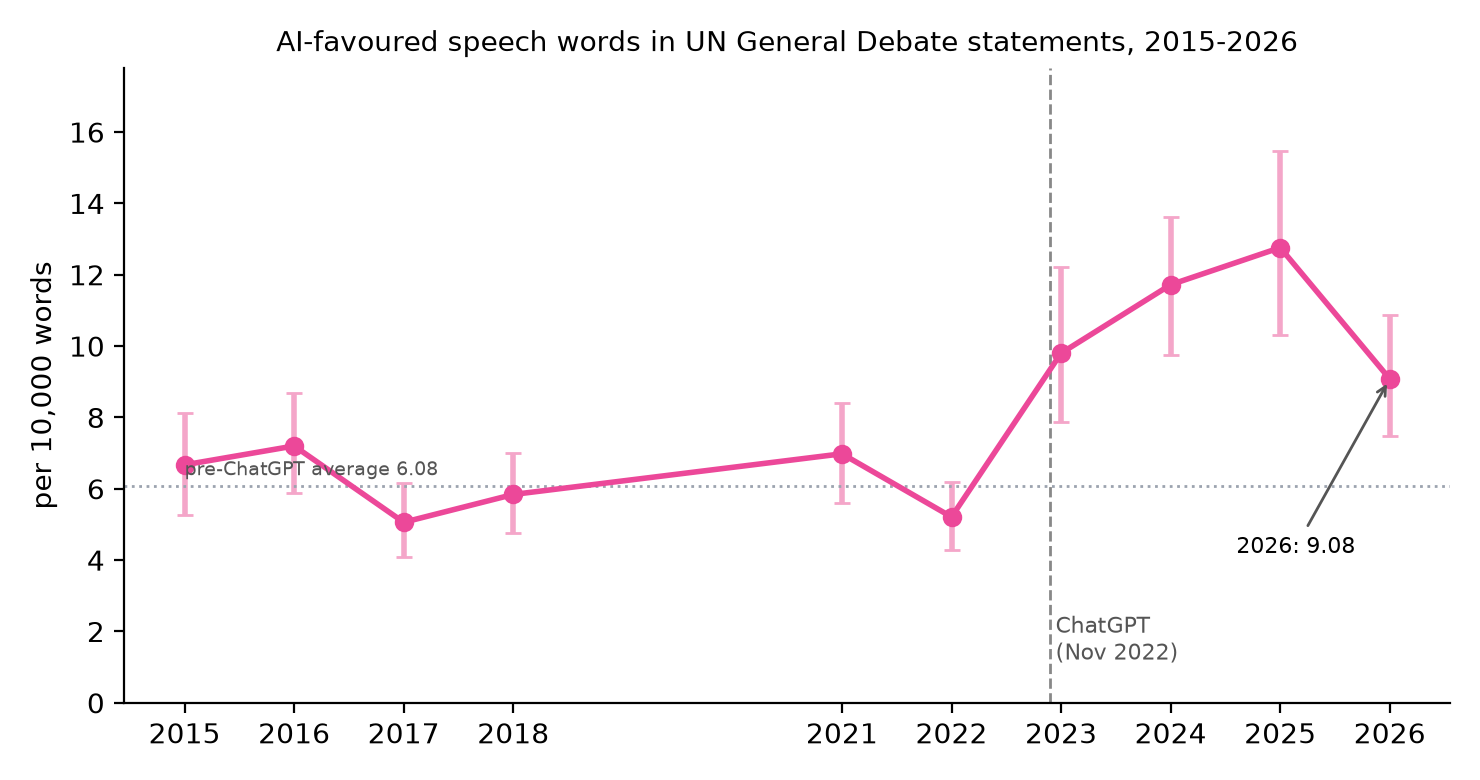
Uses per 10,000 words with 95% confidence intervals. The dotted line is the 2015-2022 average.
Taken over the whole post-ChatGPT period, the picture still points one way. Comparing every country only with its own earlier speeches, the rate across 2024-2026 rose in 76 countries and fell in 39 (sign test p = 0.0007). On its own, 2026 sits between the two periods and does not separate cleanly from either, which is exactly what a partial pullback looks like.
Which ChatGPT Words Rose or Fell in UN Speeches in 2026?
The best-known ones fell and the quieter ones kept climbing. Unwavering, foster, testament, crossroads and beacon all dropped sharply from their 2025 highs, while profound and steadfast reached new records. Figures below are uses per 100,000 words.
| Word | 2015-22 | 2023 | 2024 | 2025 | 2026 |
|---|---|---|---|---|---|
| profound | 9.0 | 14.2 | 14.6 | 25.5 | 32.9 |
| steadfast | 5.8 | 9.6 | 15.6 | 15.8 | 17.9 |
| unwavering | 6.4 | 14.7 | 19.6 | 23.1 | 11.1 |
| foster | 13.0 | 25.6 | 29.2 | 25.5 | 9.7 |
| crossroads | 1.3 | 3.7 | 6.0 | 8.5 | 3.9 |
| beacon | 3.5 | 3.7 | 4.5 | 8.5 | 2.4 |
| testament | 1.7 | 5.5 | 3.5 | 5.5 | 0.5 |
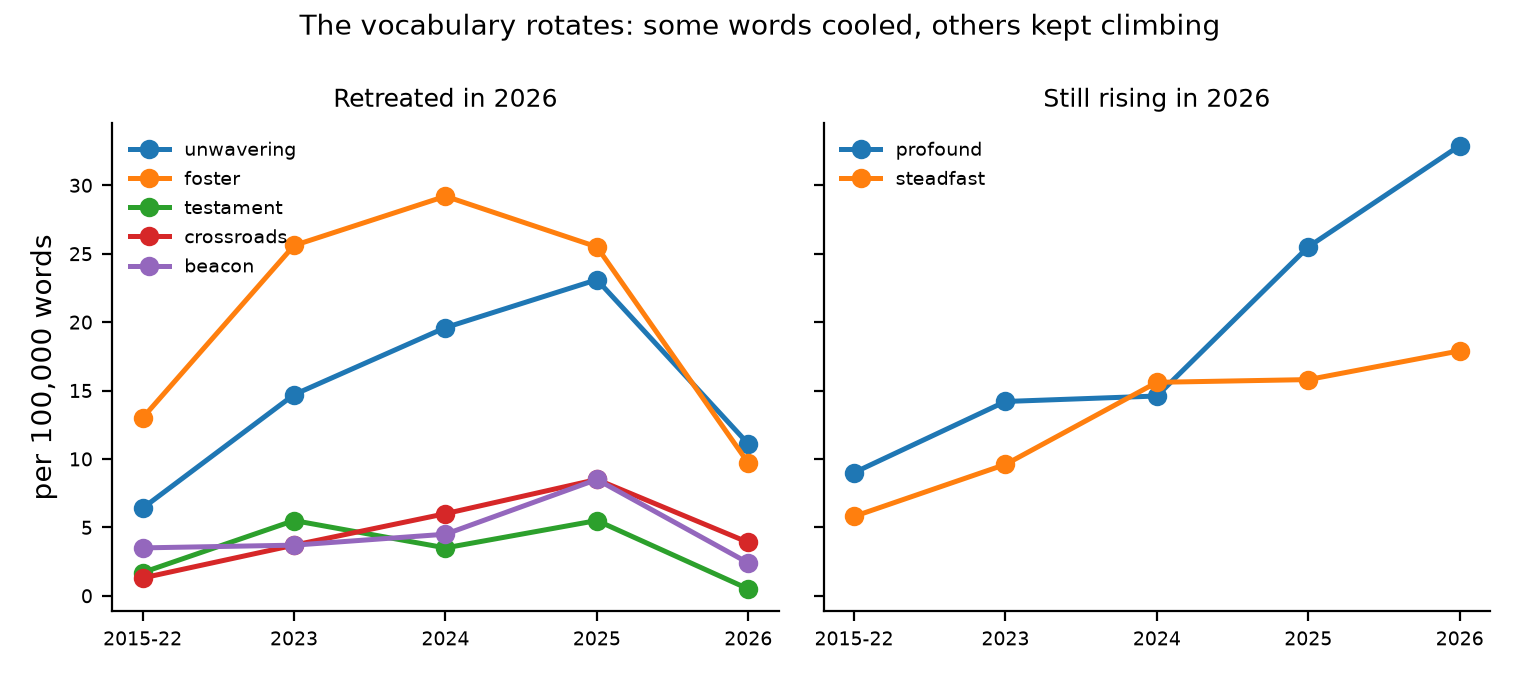
Five words retreated in 2026 and two kept rising. The overall drop hides a change of favourites.
Why Is "Profound" in So Many UN Speeches Now?
Because it kept spreading after the other ceremonial words cooled. In 2026 it appeared in 45% of English statements, against 14-20% in every session from 2015 to 2022, mostly in phrases such as profound appreciation, profound transformation and profound uncertainty. Steadfast followed the same path, reaching three times its pre-ChatGPT rate.
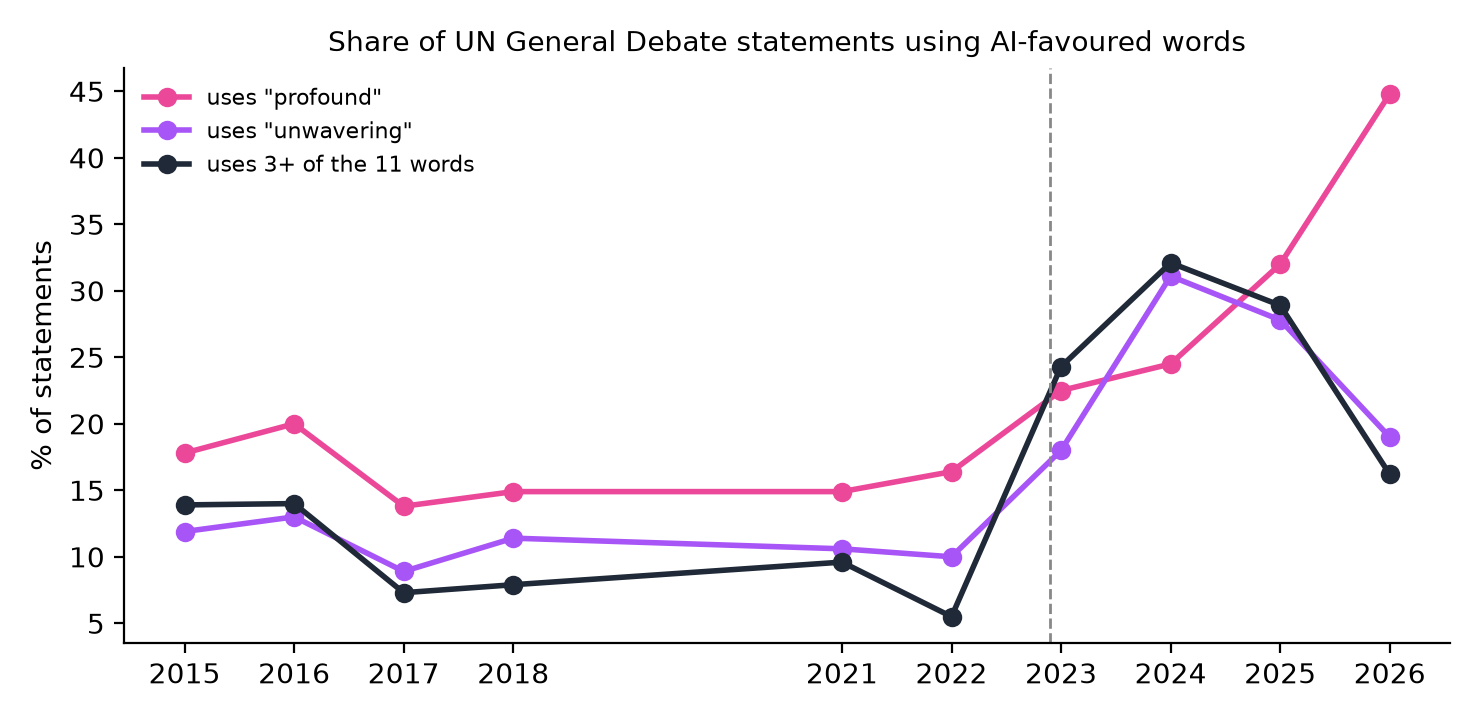
Profound climbs every year since 2022. Unwavering and the share of speeches stacking three or more of these words both peaked in 2024-2025.
The stacked pattern is telling too. The share of speeches that used three or more of the eleven words went from 5-14% before ChatGPT to 32% in 2024, and fell back to 16% in 2026.
Why Did Some AI Words Drop in 2026?
The data cannot settle it, but three explanations fit. Ceremonial phrasing has fashions, and 2025 may have been the top of one. By 2026, lists of words that sound like AI were everywhere, and testament and unwavering appear on many of them, so writers who know the lists may now avoid exactly those words. And the AI tools used for drafting in 2026 are not the ones of 2023, and may favour different phrasing.
The pattern of the retreat leans toward the last two: the most publicised words fell, the less discussed ones kept rising. The 2027 debate will test it again with the same method.
Did the First Study Predict 2026 Correctly?
Partly. Our first UN speech study, published on 17 September, five days before the debate opened, predicted the rate would stay at or above 12 per 10,000 words and that unwavering would again appear in more than a quarter of speeches. The rate eased to 9.1 and unwavering fell to 19%, while the register stayed well above its pre-ChatGPT level and profound broke its own record. A prediction written down in advance is how a measurement earns trust, and this one told us something new.
How Was the 2026 UN Speech Data Analysed?
Exactly as before, so the years are comparable. We took the statements delegations publish on the UN's own General Debate website, kept only speeches whose sole published text is English and at least 300 words, and counted the same eleven words with the same patterns. Session 81 added 105 statements and about 207,000 words.
The checks that made the first result credible still hold with 2026 included:
- Placebo. Two periods that both precede ChatGPT, 2015-2018 against 2021-2022, give 55 countries up and 53 down (p = 0.92).
- Everyday diplomatic words. Peace, security, sovereignty and five other staples show no significant majority of countries moving (p = 0.20), and barely changed from 2025 to 2026.
- Translation. Restricted to states where English is an official language, the 2024-2026 rise is stronger: 37 up, 16 down (p = 0.005).
Does This Mean World Leaders Use AI to Write Their Speeches?
No single speech can be judged this way, and the study names no country or leader. A word count shows how the language of an institution moves; it cannot show who drafted a sentence. That limit matters even more now that the favourite words are changing year to year.
The same lesson applies to any word list used as an AI test. If unwavering can lose a third of its share in a year while profound climbs toward half of all speeches, a checklist of "AI words" goes out of date faster than it is printed. When you want to know how your own draft reads, test the text itself rather than counting its adjectives.
Where Can I Read the Full Study and Data?
Everything is open. The updated preprint (version 2) is on ResearchGate, and the code, the per-statement counts for all 1,061 speeches and every figure are on GitHub, so each number here can be rebuilt from the UN's own website. The earlier abstracts study, The Fingerprint Is Leaking Into the Record, tracks the same kind of drift in scientific writing.
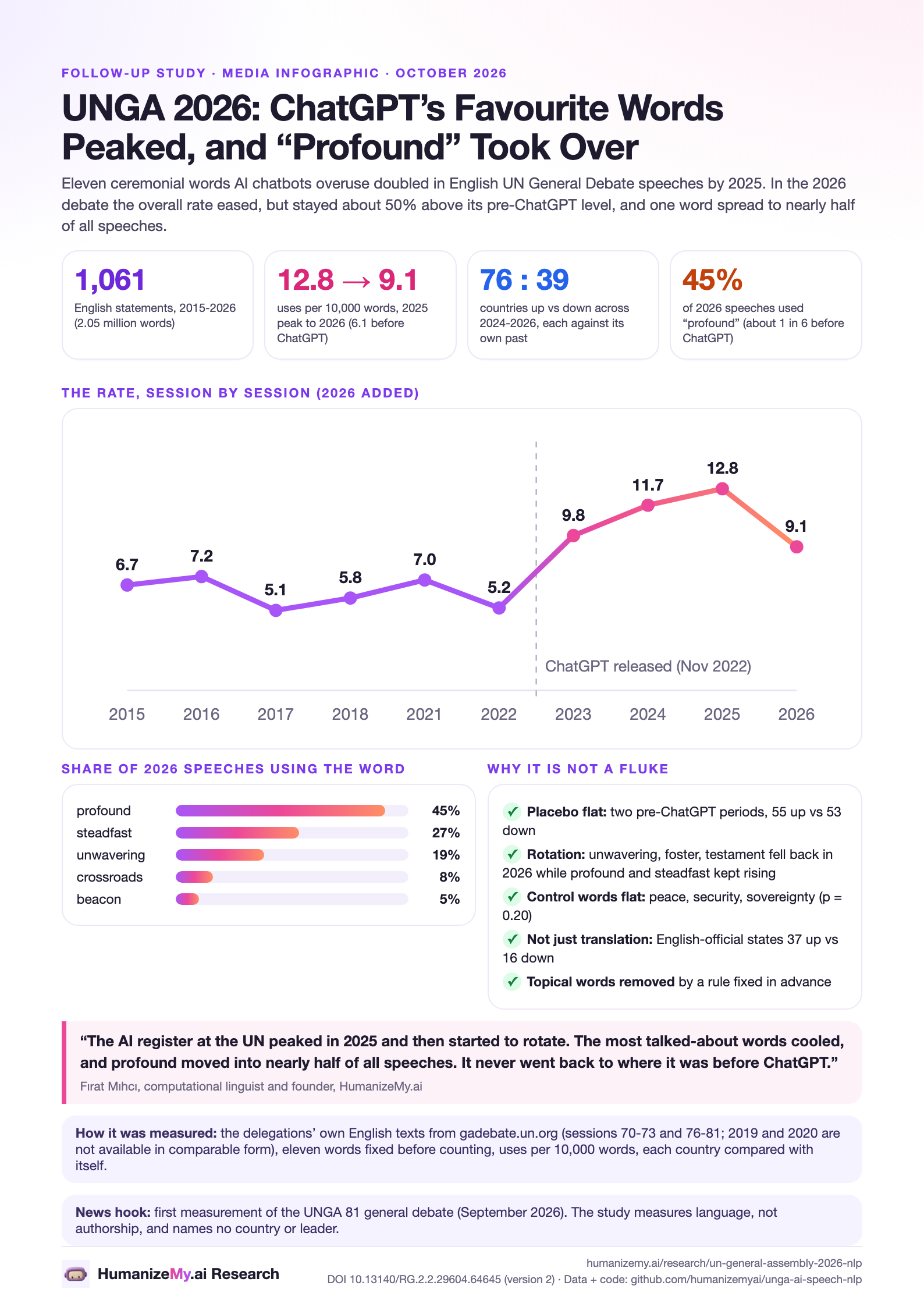
Journalists and editors can use the one-page infographic and the three-page press brief freely with credit to HumanizeMy.ai.
About the author
Fırat Mıhcı researches the humanization of machine-generated writing. UNGA 2026: ChatGPT's Favourite Words Peaked, and "Profound" Took Over sits in that same line of work, built on 2,590 real student essays he published while building HumanizeMyAI. Publication record at ResearchGate.
Where is the full text of "UNGA 2026: ChatGPT's Favourite Words Peaked, and "Profound" Took Over"?
The preprint holds the complete method, every figure and the data behind "UNGA 2026: ChatGPT's Favourite Words Peaked, and "Profound" Took Over".