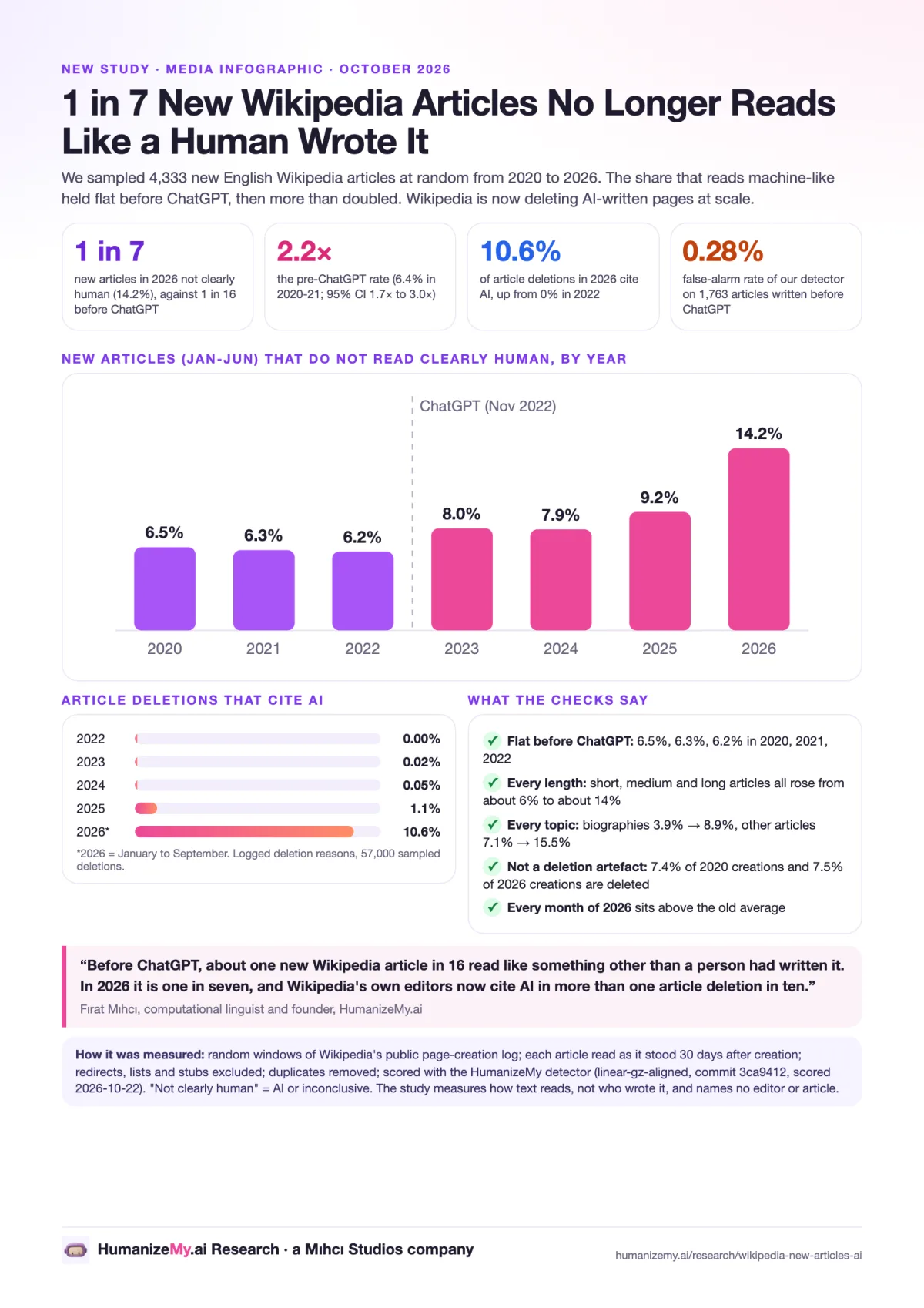
Before ChatGPT, about one new English Wikipedia article in 16 did not read clearly human. In 2026 it is one in seven. We drew 4,333 new articles at random from Wikipedia's public page-creation log for 2020 to 2026, read each one as it stood 30 days after creation, and scored its prose with the detector behind our free AI checker. The share that no longer reads clearly human held flat for three years, then climbed to 14.2% in 2026, 2.23 times the 2020-21 rate. Over the same months, Wikipedia's own deletion log began to cite AI in more than one article deletion in ten.
How Much of New Wikipedia Now Reads Like AI?
In January to June 2026, 14.2% of new English Wikipedia articles no longer read clearly human on our detector, against 6.4% in 2020 and 2021. That is 85 of 599 articles in 2026 and 75 of 1,178 before ChatGPT: a gap of 7.8 percentage points (95% CI 4.8 to 11.0) and a ratio of 2.23 (95% CI 1.66 to 3.02), with z = 5.45.
"Not clearly human" means the detector did not return a Human verdict: the article scored Inconclusive or AI Detected. The strict AI Detected verdict moves the same way from a lower base, from 0.17% of 2020-21 articles to 1.0% in 2026. Prose can read machine-like for several reasons, so the study measures how the text reads rather than who typed it; the signals involved are the ones behind what makes text read as human.
Is AI Content on Wikipedia Increasing Year by Year?
Yes, and the climb begins where ChatGPT arrives. The three pre-ChatGPT years are almost identical at 6.5%, 6.3% and 6.2%; the share edges up to 8.0% in 2023 and 7.9% in 2024, reaches 9.2% in 2025 and jumps to 14.2% in 2026.
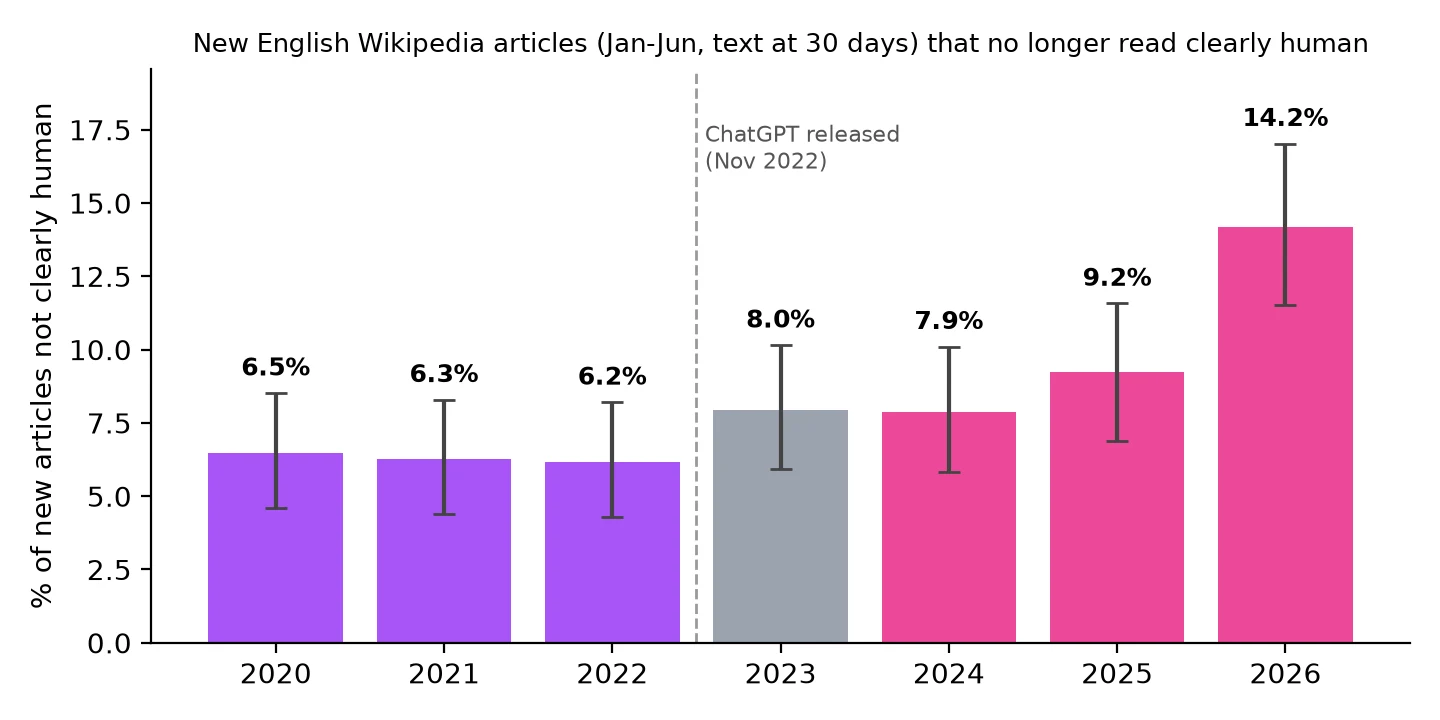
Share of each year's January to June articles, text at 30 days after creation, with 95% bootstrap intervals.
| Year (Jan to Jun) | Articles | Not clearly human | Share | 95% CI |
|---|---|---|---|---|
| 2020 | 587 | 38 | 6.5% | 4.6% to 8.5% |
| 2021 | 591 | 37 | 6.3% | 4.4% to 8.3% |
| 2022 | 585 | 36 | 6.2% | 4.3% to 8.2% |
| 2023 | 591 | 47 | 8.0% | 5.9% to 10.2% |
| 2024 | 584 | 46 | 7.9% | 5.8% to 10.1% |
| 2025 | 596 | 55 | 9.2% | 6.9% to 11.6% |
| 2026 | 599 | 85 | 14.2% | 11.5% to 17.0% |
Pooled over 2024 to 2026 the share is 10.5% (z = 3.84 against 2020-21). The mean detector score rose from 6.4 to 9.3 out of 100, and the number of articles scoring above 50 went from none in 2020 to 11 in 2026. Register drift after ChatGPT is not unique to the encyclopedia: our lab tracked it in speeches at the UN General Assembly as well.
How Did We Measure AI Writing in New Wikipedia Articles?
We sampled the public page-creation log at random, read each new article as it stood 30 days after creation, and scored only its running prose. For every month from January to June of 2020 to 2026, plus July and August 2026, a seeded generator picked six random starting times and we read the next 500 article creations after each one: 132,000 log events in all.
- Kept: pages that are still articles today and had at least 150 words of prose at day 30, up to 100 per month.
- Excluded: redirects (79,859, the bulk of all creations), disambiguation pages (1,326), lists, indexes, outlines, timelines and year-in pages (876), creations by bot-group accounts (4) and pages under 1,500 bytes today (3,729).
- Prose only: templates, references, tables, files, categories, headings, lists and everything from the References, See also and External links sections onward were stripped before scoring.
- Cleaning: of 4,400 articles fetched, 59 restored old pages, 1 exact duplicate, 4 near duplicates and 3 garbled extractions were dropped, leaving 4,333.
- Instrument: the HumanizeMy detector, model linear-gz-aligned at code commit 3ca9412, run locally from the same code that powers the public checker, with every article scored on 22 October 2026.
All text came through the public MediaWiki API, with an identified user agent and at most one request per second.
Can an AI Detector Tell Wikipedia Prose From AI Prose?
Yes, and we tested that before reading a single post-ChatGPT article. On 1,763 articles created in 2020 to 2022, before ChatGPT existed, the detector returned AI Detected for just 5 of them (0.28%, upper 95% bound 0.66%), comfortably inside the 1% gate we set in advance.
Wikipedia's house style is formal, which is exactly why every comparison runs against Wikipedia's own pre-ChatGPT baseline, measured with the same instrument on the same kind of text. The formality of encyclopedic prose did not change between 2020 and 2026; the machine-like share did. Two placebo tests inside the pre-ChatGPT years find no movement at all: 2020 against 2021 gives z = -0.15, and 2022 against 2020-21 gives z = -0.17. For the general method behind numbers like these, see how AI detector accuracy is measured, or run a paragraph through the same detector and read its verdict yourself.
Does the Rise Hold for Short and Long Wikipedia Articles?
Yes. Short, medium and long articles all roughly doubled, and weighting 2026 to the pre-ChatGPT length mix still gives 14.2%, so longer articles do not explain the result.
| Length | Articles 2020-21 | Share 2020-21 | Articles 2026 | Share 2026 | z |
|---|---|---|---|---|---|
| 150 to 260 words | 502 | 6.4% | 216 | 14.4% | 3.47 |
| 260 to 450 words | 355 | 6.8% | 201 | 14.4% | 2.96 |
| 450 words and more | 321 | 5.9% | 182 | 13.7% | 2.98 |
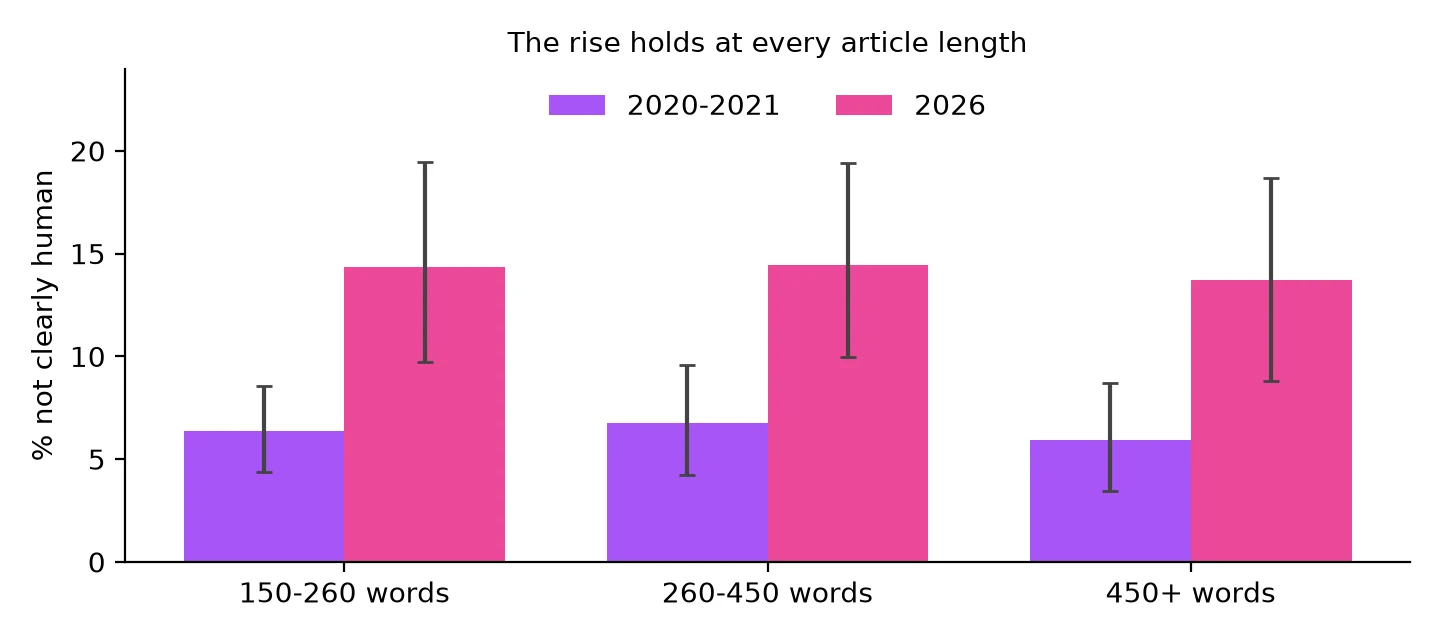
Each length band, 2020-21 against 2026, with 95% intervals.
Topic does not explain it either. Biographies rose from 3.9% to 8.9% (z = 2.03) and all other articles from 7.1% to 15.5% (z = 5.02), while the share of biographies in the sample stayed near 20%.
Was the 2026 Jump a One-Month Spike?
No. Every month of 2026 sits between 10% and 20%, well above the 6.4% pre-ChatGPT average, on about 100 articles per month. January to June (14.2%) and July to August (13.0%) do not differ, and across January to August the share is 13.9% of 799 articles.
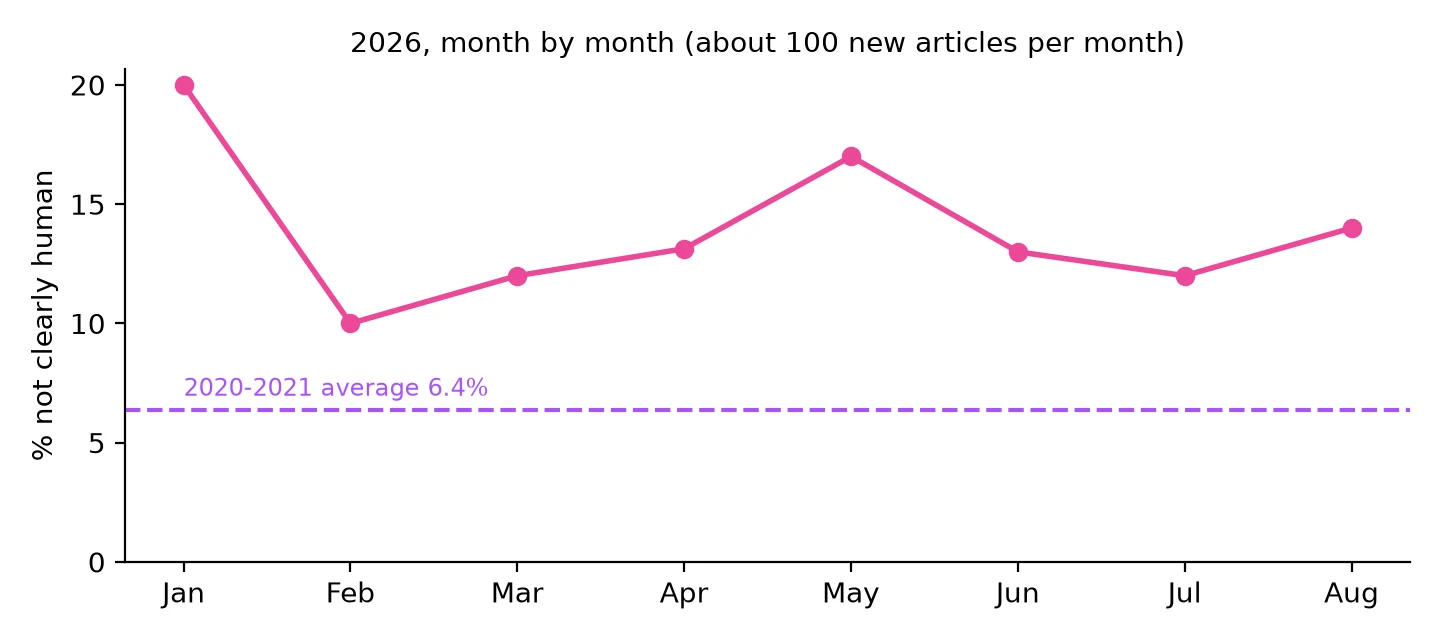
Monthly share in 2026 against the 2020-21 average.
How Many Wikipedia Articles Are Deleted for AI Content?
In January to September 2026, 10.6% of sampled article deletions on English Wikipedia gave AI or language-model generation as the logged reason, about one in nine. In 2022 the count was zero.
| Year | Deletions sampled | Article deletions | Reason cites AI | Share of article deletions |
|---|---|---|---|---|
| 2022 | 12,000 | 6,362 | 0 | 0.00% |
| 2023 | 12,000 | 6,331 | 1 | 0.02% |
| 2024 | 12,000 | 6,054 | 3 | 0.05% |
| 2025 | 12,000 | 5,688 | 61 | 1.07% |
| 2026 (Jan to Sep) | 9,000 | 5,065 | 537 | 10.60% |
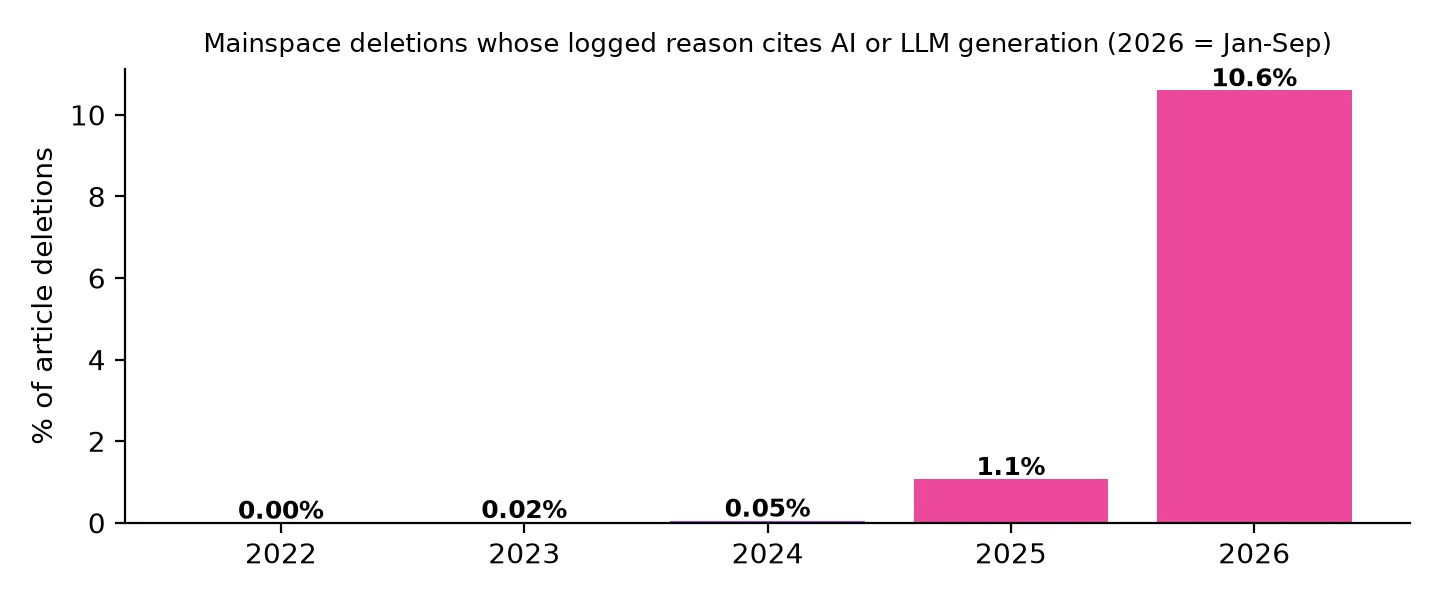
Share of sampled article deletions per year whose logged reason cites AI.
We read the logged reasons of 57,000 randomly sampled article-space deletions and sorted them with fixed patterns, keeping counts only. Most 2026 cases are expired proposals to remove LLM-generated content and speedy deletions of unreviewed LLM-generated pages, a deletion criterion Wikipedia added for such pages. The single 2023 match is a duplicate article about a chatbot, a false match kept for transparency. Pages removed for other stated reasons, such as advertising or notability, count as ordinary deletions here, so the AI share is a lower bound.
Could Deleted Pages Explain the Rise?
No. The sample holds only pages that still exist, so we measured deletion directly: 7.4% of 2020 creations and 7.5% of 2026 creations are gone today, and every year from 2020 to 2026 lies between 6.3% and 9.6%. Older cohorts have not lost more of their pages.
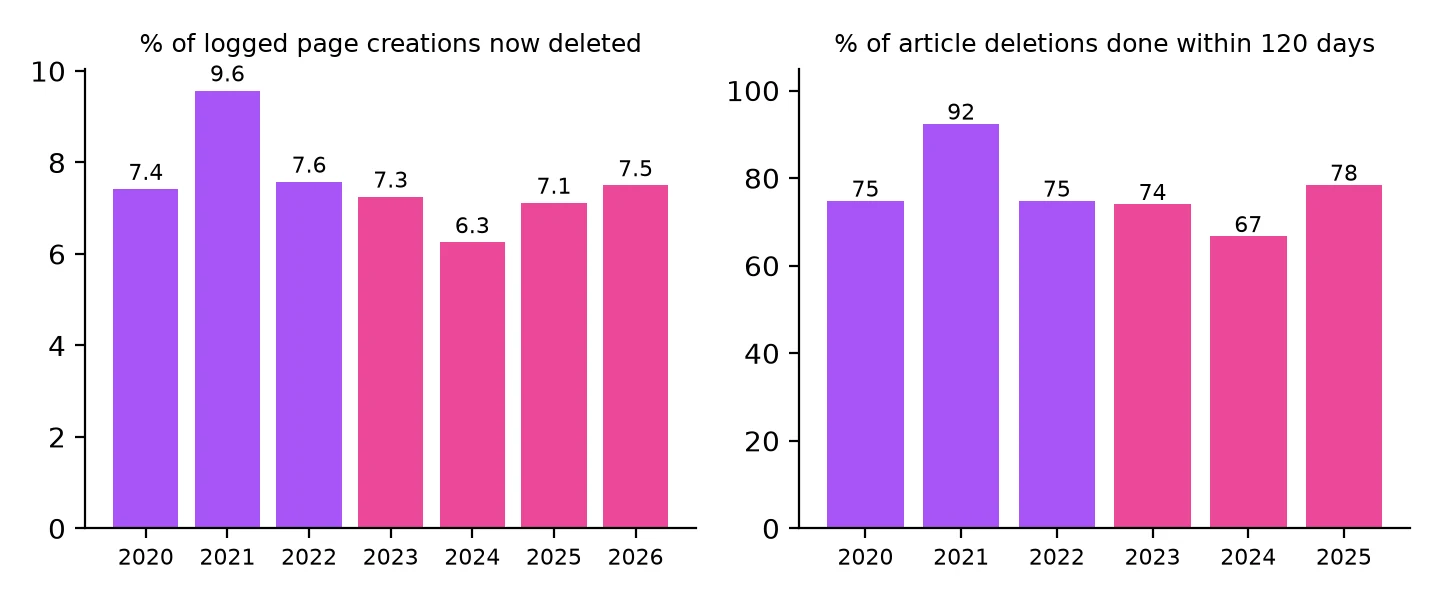
Deletion is flat across creation years and mostly happens within weeks.
Wikipedia deletes fast. The median article deletion came 5 to 25 days after creation, and 67% to 92% of article deletions in 2020 to 2025 happened within 120 days, an age the January to June 2026 pages in the sample have reached or nearly reached. Inside 2026, the older pages read no more human than the newer ones (14.0% for January to March, 13.0% for June to August).
The remaining room for bias has a number. Closing the whole gap would require every 2020-21 article deleted after 120 days to read not clearly human, against 6.4% among its surviving peers; closing even half of it would need 53%, about eight times the survivor rate. In the other direction, 13.6% of the deleted 2026 creations we traced cite AI, so the 2026 survivors have already been cleaned up once.
Does This Mean Wikipedia Editors Use AI?
The study cannot say that about any person, and it does not try: no editor and no article is assessed or named, and every result is an aggregate share. Prose can read machine-like after AI drafting, AI copyediting or machine translation, or because writers absorb the register that chatbots spread, an effect our lab measured in AI vocabulary leaking into human scientific writing.
Word counts alone would not have settled the question. The 21 style words that language models overuse rose from 2.89 to 4.81 uses per 10,000 words between 2020-21 and 2024-26 while encyclopedic control words did not rise, but 2022 already stood at 4.34 and 2026 on its own is not significant. That fits our earlier finding that single words do not separate AI from human prose, and it is why the headline rests on the detector. New articles have not converged on a template either: their mean pairwise similarity stayed inside the pre-ChatGPT range.
How Does This Compare With Earlier Estimates of AI on Wikipedia?
The best-known earlier figure is a single month. A 2024 study by Brooks, Eggert and Peskoff (arXiv 2410.08044) estimated that about 5% of new English articles from August 2024 contained substantial AI content. Our series measures how new articles read over seven years with one sampling design: 7.9% for January to June 2024, 14.2% for 2026, against a measured 6.4% baseline from before ChatGPT.
Three things are new here: the pre-ChatGPT baseline and the trend are measured rather than assumed, the detector's false-positive rate on Wikipedia text is reported before any later text is interpreted, and two of Wikipedia's own records, the deletion log and the survival of sampled creations, are added alongside.
Why Does Machine-Like Prose on Wikipedia Matter?
Because Wikipedia is read by people and learned by machines. Almost every large training corpus includes English Wikipedia, often weighted up because it is clean and factual, and models trained on their own output lose the rare edges of human language (Shumailov et al., 2024). Each model trained on a later snapshot of the encyclopedia sees more of its predecessors' style.
The two records in this study point the same way. On the article side, a flat baseline gives way to a slow climb and a sharp rise in 2026; on the deletion side, AI went from almost never being a reason to remove an article to more than one deletion in ten. Wikipedia is absorbing machine-like prose and pushing back against it at the same time.
Can I Reuse the Wikipedia Study Figures and Data?
Yes. The full preprint, One in Seven: The Share of New English Wikipedia Articles That No Longer Read Clearly Human Has More Than Doubled Since ChatGPT (Mıhcı, 22 October 2026), is on ResearchGate (DOI 10.13140/RG.2.2.24928.24320) under a CC BY 4.0 licence, with the method, every table and a limitations section. The code and the aggregate tables behind every number are open: the sampler, the prose extractor, the fixed word lists, the deletion census, the survivorship check, the statistics and a verification script that recomputes each headline figure from the raw data with separate code. Page identifiers and article text are not part of the release, by design, so no article can be traced from it. Because the sampler is seeded and uses the public API, anyone can rebuild the sample.
Journalists and editors can use the infographic below freely with credit to HumanizeMy.ai. To see how a passage of your own reads, scan your text free with the detector used for this study.
About the author
Fırat Mıhcı is a computational linguist who measures how public writing shifts as language models spread. 1 in 7 New Wikipedia Articles No Longer Reads Like a Human Wrote It applies the detector behind HumanizeMyAI's free AI checker to seven years of new encyclopedia articles. Publication record at ResearchGate.
Where is the full text of "1 in 7 New Wikipedia Articles No Longer Reads Like a Human Wrote It"?
The preprint holds the complete method, every figure and the data behind "1 in 7 New Wikipedia Articles No Longer Reads Like a Human Wrote It".