Open Alanya's online reviews in just one language and you would think you were reading about a different town each time. That is the starting point of this study: for the Alanya City Council (Alanya Kent Konseyi), we used artificial intelligence to read 12,222 public reviews of 49 Alanya businesses and sites (hotels, restaurants, beaches and historic attractions) written over nine years in more than a dozen languages. For the first time, Alanya has an evidence-based, destination-wide picture of what its visitors actually experience, broken down by the language, and so broadly the nationality, of the guest.
One destination, many Alanyas
Different guests do not experience the same city, and the gap is not subtle (chi-square = 319, p < 0.0000001). When we measured which words each visitor community uses far more than the others, four distinct portraits emerged:
- English-speaking guests rave about food. Their most distinctive words are amazing, best, lovely and great, and the topic they return to most is food. For them, Alanya is judged at the table.
- German-speaking guests keep score. Their tell-tale vocabulary mixes praise and warning in the same breath: highly recommended and friendly, but also unfriendly and unfortunately. Germans weigh service and value, and they say so the moment either slips.
- Russian-speaking guests come for the coast. Their signature words are sea, beach, sun loungers, fortress and nearby. The experience, for them, is the shoreline.
- Turkish-speaking guests talk about people. Their most distinctive words are courtesies and names: Mr, Ms, thank you, attention, even individual staff members by name. Domestic guests remember who served them.
One destination, four expectations. A campaign or a service standard that works for one of these audiences can quietly miss the others.
Why a humanizer lab studied tourism reviews
We build language tools. HumanizeMyAI is trained on a published corpus of 2,590 real student essays, and the skill behind it (reading human writing carefully across registers and languages) applies well beyond essays. So when the Alanya City Council wanted to understand what visitors actually say about the city, across the dozen languages its guests write in, it was a natural collaboration. The full methodology, statistics and limitations live in the preprint; here we walk through how it works and what 12,000 voices turned out to be saying.
The data: 12,222 reviews, eight languages, nine years
The corpus is 12,222 public reviews of 49 Alanya venues (hotels, restaurants, beaches and historic attractions) from 2017 to 2026. Of those, 8,540 carry free text; the rest are ratings only. The text spans eight language cohorts: Turkish, English, Russian, German, Polish, Dutch, Danish, and a pooled "Other" that gathers fifteen smaller languages.
Two honesty notes shape everything downstream. First, reviewer names were hashed and discarded at the moment of ingestion, and every result is reported only in aggregate, in line with Türkiye's data-protection law (KVKK). Second, the platforms do not expose a reviewer's nationality, so we use the language a review is written in as a proxy: findings describe language communities, not verified passports, and we say so plainly throughout.
The pipeline: small specialized agents, one assembly line
The study runs as a chain of focused stages, each one a small agent that does a single job and hands off to the next. Discovery builds the venue list. Collection pulls each venue's public review feed. Preprocessing cleans the text, detects the original language, and produces an English rendering for the cross-language steps while keeping the original for native-language analysis. Analysis layers on sentiment, aspect detection and topic modelling. Statistics runs the formal tests. A forecasting stage handles the demand outlook, and a reporting stage renders the figures and tables.
The point of this shape is that it is cheap, transparent and repeatable. The whole study can be re-run next season for almost nothing, which is exactly what a civic body needs: not a one-off consultant report, but a standing instrument it can refresh on demand.
We checked the AI against reality
We score sentiment on the original-language text with a multilingual model, then do something most review studies skip: we validate the model against the reviewer's own star rating. Predicted sentiment tracks the observed star at a mean absolute error of 0.68 stars (Spearman correlation 0.58): the sanity check that earns the right to trust everything after it. On top of that we run aspect-based analysis over a nine-aspect schema (cleanliness, service, food, location, value, room, beach and sea, pool, atmosphere) (23,437 aspect mentions across 7,600 reviews) and a topic model that surfaces 37 coherent themes, from kebab and seafood to the castle, the cave and Cleopatra Beach.
Finding 1: the locals are the toughest critics
Sentiment differs sharply across language communities (Kruskal–Wallis H = 392, p < 0.0000001). The Turkish-language cohort sits at a median sentiment of 0.5 while every international cohort sits at 1.0. In plain terms, domestic Turkish-speaking visitors are consistently more critical than foreign visitors. Alanya's headline star average is real, but it is buoyed by a more forgiving international majority, and tracking the domestic signal separately is an earlier warning system than the blended number.
Finding 2: value-for-money decides the bad reviews
A logistic model predicting a low rating from the aspects a review mentions, its sentiment, the venue type and the season tells a clear story. Controlling for everything else, a review that raises value or price is 38% more likely to be a low rating (odds ratio 1.38): the strongest aspect effect in the model. And value sentiment is weakest of all at the beaches, where it scores just 0.155 out of 1. If the city wanted one lever, transparent and fair beach pricing would be it.
Forecasting the 2026 summer, honestly
There is no continuously published monthly arrivals series for Antalya, so fitting a heavy seasonal time-series model would mean inventing the history it needs. We refused to do that. Instead we used a transparent projection anchored in real numbers: the actual 2025 monthly curve for shape, the official annual totals for trend, and the observed early-2026 signal for direction. The projection puts roughly 6.8–7.4 million foreign visitors in the Antalya region across July–September 2026 (about 2.0–2.4 million for Alanya) at, or slightly below, the strong 2025 season. We also asked whether online review activity tracks arrivals; the seasonal alignment is strong, but our sampling cannot prove a leading indicator, and we labelled it as alignment rather than claiming more.
What this has to do with humanizing AI text
The thread connecting tourism reviews to an AI humanizer is the same discipline: read human language at scale, across registers and languages, and stay honest about uncertainty. The 2,590-essay corpus behind our humanizer and the 12,222-review corpus behind this study come from one philosophy: real human text measured carefully and reported plainly. The same instinct sits behind our internal AI detector. If you want the fuller story of how a real-corpus approach behaves differently, the 2,590-essay corpus deep dive is the companion read.
Open data, open code
This is not a black box. The complete methods, every statistic, all figures and a frank limitations section are in the preprint on ResearchGate, and the analysis code plus a fully de-identified dataset (no review text, no personal identifiers) are openly available on GitHub. The work was conducted with the Alanya City Council as a civic contribution, and the pipeline re-runs each season at almost no cost: the first of more studies to come.
About the author
Fırat Mıhcı built HumanizeMyAI on a published 2,590-essay corpus; What 12,000 Tourists Say About Alanya comes from the same close reading of student prose. Publication record at ResearchGate.
Read the full study
Complete methods, every statistic, all figures and a frank limitations section, plus the analysis code and a fully de-identified dataset.
In the press
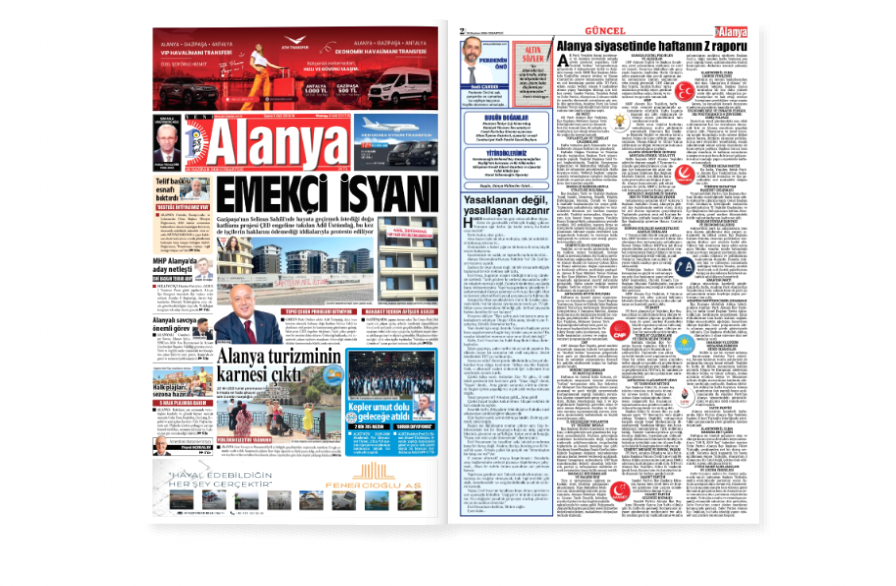
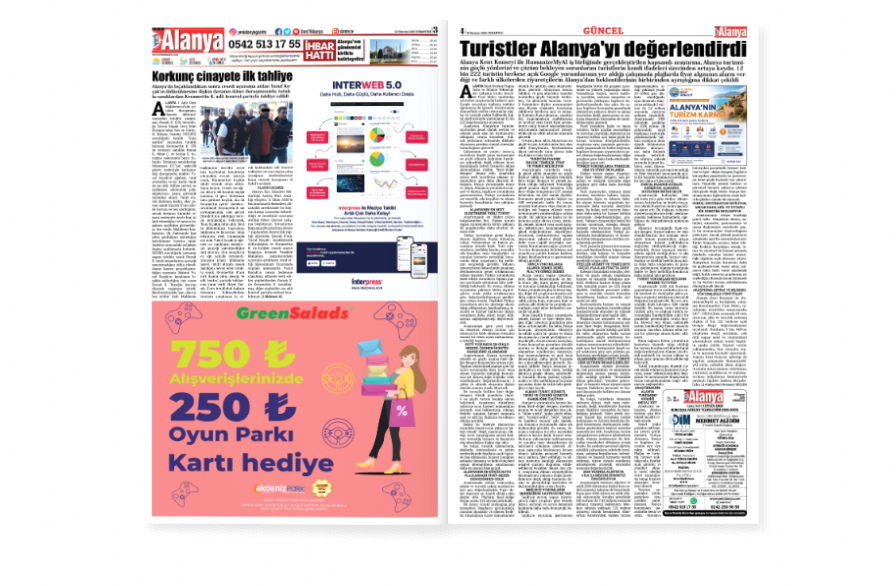
Outlets covering this study, in partnership with Alanya Kent Konseyi (Alanya City Council).