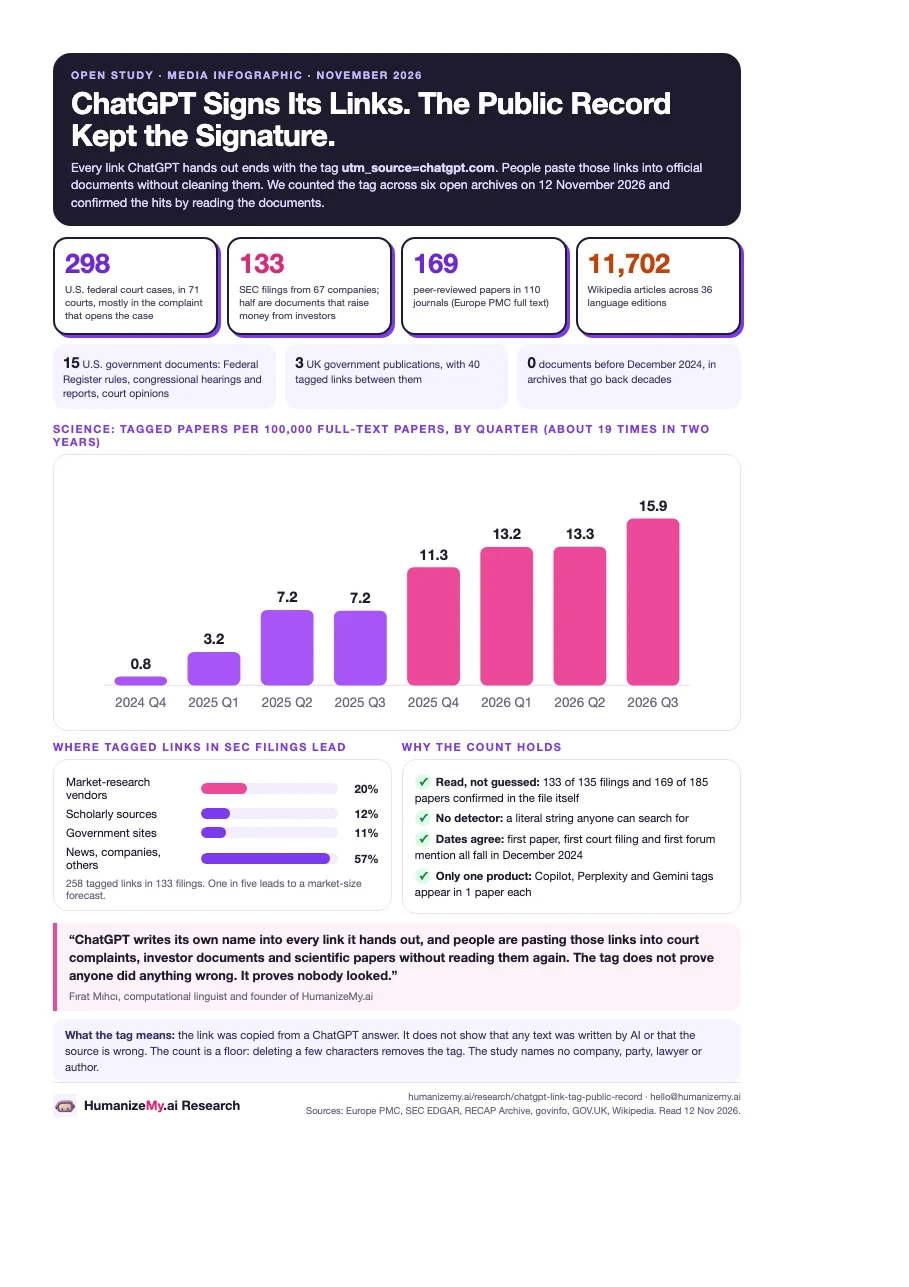
ChatGPT writes its own name into every link it hands out, and people are filing those links with courts, regulators and journals. When the chatbot answers with a web address, the address ends in utm_source=chatgpt.com. We searched six open archives for that exact string on 12 November 2026 and opened the documents to confirm it. It sits in 298 U.S. federal court cases across 71 courts, 133 SEC filings from 67 companies, 169 peer-reviewed papers in 110 journals, 18 government documents in the United States and the United Kingdom, and 11,702 Wikipedia articles in 36 languages. Not one of them is older than December 2024.
Where Does ChatGPT's Link Tag Show Up in the Public Record?
In every archive we searched: federal courts, the SEC, scientific journals, two national governments and Wikipedia. Almost every search hit held up when we opened the document, so these are lists of real files that anyone can check, not estimates.
| Archive | Search hits | Confirmed in the document | Spread |
|---|---|---|---|
| U.S. federal court cases (RECAP Archive) | 298 | 295 show the full tag in the result | 71 courts |
| SEC filings (EDGAR full-text search) | 135 | 133 | 67 companies |
| Peer-reviewed papers (Europe PMC) | 185 | 169 | 110 journals |
| U.S. government documents (govinfo) | 21 | 15 | 5 collections |
| UK government publications (GOV.UK) | 3 | 3 | 3 public bodies |
| Wikipedia articles | 11,702 | literal match in the source | 36 language editions |
From federal courts to government rule books
The tag is a literal string, so the study needed no AI detector. A detector gives a probability that someone can dispute; this gives a list of documents. It is the same reason our lab keeps two kinds of evidence apart in its other work, from what new Wikipedia articles read like to the words world leaders now use at the UN.
What Does the ChatGPT Link Tag Actually Prove?
It proves one thing with certainty: the link reached the author through a ChatGPT answer. It does not prove that any sentence was machine-written, that the source is wrong, or that anyone broke a rule.
The tag exists so that the website receiving the visit can see in its analytics that the visitor came from ChatGPT. Its side effect is a fingerprint. A writer who copies the link from the answer and pastes it into a document carries the tag along, and no person types that string by hand. In the words of the study: the tag does not prove anyone did anything wrong. It proves nobody looked at the link again before the document went out.
When Did the Tag First Appear in Official Documents?
In December 2024, and nowhere earlier. The archives reach back decades, yet the first confirmed paper was published on 13 December 2024, the first tagged court documents were entered that same month, and the first SEC filing is dated 28 January 2025.
Those dates line up with the period when ChatGPT began answering with live web links. A tag that appeared in older documents, or in similar numbers for products that add no tag, would have undercut the whole reading. Neither happened.
How Fast Is the Tag Spreading in Scientific Papers?
About 19 times in under two years. Among open-access papers the rate rose from 0.85 per 100,000 full-text papers in the last quarter of 2024 to 15.95 in the third quarter of 2026, which is about one paper in 6,300.
About 19 times in under two years
| Quarter | Full-text papers | Tagged papers | Per 100,000 |
|---|---|---|---|
| 2024 Q4 | 235,613 | 2 | 0.85 |
| 2025 Q1 | 250,338 | 8 | 3.20 |
| 2025 Q2 | 235,698 | 17 | 7.21 |
| 2025 Q3 | 251,703 | 18 | 7.15 |
| 2025 Q4 | 265,583 | 30 | 11.30 |
| 2026 Q1 | 264,774 | 35 | 13.22 |
| 2026 Q2 | 248,844 | 33 | 13.26 |
| 2026 Q3 | 219,396 | 35 | 15.95 |
The 169 papers come from 110 journals, and their spread follows publishing volume: the six publishers that appear most often are among the largest open-access houses. Only 21 papers carry the tag in the reference list. In the rest it sits in the running text, in footnotes, or in the statements that say where the data and code live, places that editors and reviewers rarely read link by link.
What Did People Use ChatGPT to Look Up?
Official guidance in science, and market-size forecasts in money-raising filings. The links show what people asked the chatbot for: in papers, 75 of 272 tagged links (28%) lead to government or intergovernmental bodies, with the World Health Organization and the U.S. Food and Drug Administration near the top of the list.
| Where the tagged links lead | Papers (272 links) | SEC filings (258 links) |
|---|---|---|
| Government and intergovernmental bodies | 75 | 28 |
| Scholarly publishers and repositories | 23 | 32 |
| Market-research vendors | 3 | 52 |
| News, companies and other organisations | 171 | 146 |
One SEC link in five goes to a market forecast
Many of those scientific sources are exactly the right ones. The open question the tag raises is a different one: whether a person read the source, or only the chatbot did.
Why Do SEC Filings Matter Most?
Because half of them are the documents a company files when it asks investors for money. Of the 133 confirmed filings, 67 are offering or registration documents, 34 are periodic or current reports, 25 are proxy materials and 7 are other forms.
Half of them ask investors for money
One in five tagged links in those filings, 52 of 258, points to a market-research vendor, the firms that publish forecasts of how large a market will grow. Put plainly, the number that tells an investor how big the opportunity is was often found by asking a chatbot, and the filing shows no sign that anyone compared it with a second forecast. A language model's choice of which figure to surface is not a neutral one.
Which Federal Courts Have the Most Cases With the Tag?
The Southern District of New York, with 55 cases, then the Northern District of California with 31 and the Central District of California with 27. Those three districts hold 113 of the 298 cases; the rest spread across 68 other federal courts.
| Court | Cases |
|---|---|
| S.D.N.Y. | 55 |
| N.D. Cal. | 31 |
| C.D. Cal. | 27 |
| D.D.C. | 11 |
| N.D. Ill. | 11 |
| E.D. Va. | 9 |
| S.D. Fla. | 9 |
| 64 other courts | 145 |
The tagged document is most often the complaint that opens a case, followed by motions, notices of removal and memoranda. Where the type of case is recorded, copyright (30), other statutory actions (28), civil rights (27), personal injury (23), antitrust (15) and patent (15) lead. In 254 of the cases counsel is listed, so this is not a trace left only by people representing themselves.
Copyright cases carry the tag most often
Is the Tag in Government Documents Too?
Yes, on both sides of the Atlantic. In the U.S. Government Publishing Office archive we confirmed 15 documents: five Federal Register rule documents, four congressional hearing records, two congressional committee reports, two federal court opinions and two other publications.
Hearing records include testimony from outside witnesses, so a tag there may come from a witness rather than from staff. In the United Kingdom three publications from three public bodies carry the tag in their attached documents, 40 times in all, and one document alone holds 32 of them.
How Many Wikipedia Articles Carry the Tag?
11,702 live articles across 36 language editions, led by English with 3,166, then Spanish (1,386), Japanese (805), German (691), Italian (666), Chinese (500) and French (477). English Wikipedia holds a further 394 drafts with the tag.
Volunteer editors list the tag among the signs of chatbot-assisted editing and remove it when they find it, so the live count is what is left after cleaning, not everything that was ever added.
11,702 articles in 36 languages
Do Other Chatbots Leave a Trace Like This?
Barely, because most of them do not tag the links they give. In the same paper archive the ChatGPT tag appears in 185 papers; the tags for Copilot, Perplexity and Gemini appear in one paper each, and none for Claude.
The two-year-old ChatGPT tag already outnumbers the tag for Google (75 papers), Twitter (33) and newsletters (32) put together. This is not a market-share measure. It shows that the public record can be read this way for one product only, because of one design decision, and that the window could close if the tag changes.
How Did We Count and Check Every Document?
We searched each archive for the exact phrase on 12 November 2026, then downloaded every paper, SEC filing and government document and matched the literal string in the file itself. A document counts only if the string is in the downloaded file.
- Archives: Europe PMC (12,506,278 full-text papers), SEC EDGAR full-text search, the RECAP Archive of federal court filings, govinfo, GOV.UK and the source text of 36 Wikipedia editions.
- Checking: 133 of 135 SEC hits and 169 of 185 paper hits were confirmed; the rest were dropped. Typeset documents often break a link across lines, so white space was removed before matching.
- Courts: bulk download of filings is not open, so for the 298 court results we recorded whether the search result shows the complete tag (295 do).
- Link destinations: every distinct tagged link was sorted into four groups by fixed rules written before the totals were known.
- Naming: the study reports counts by category and names no company, party, lawyer or author. A tag shows how a link was found, not misconduct.
Is This the Full Count of ChatGPT Use?
No, it is a floor. One keystroke removes the tag, and so do reference managers and careful copy editors, so the count holds only the documents where nobody read the link closely enough to notice it.
The archives are also partial: open-access papers, the federal filings that users contribute to the public archive, and published government documents. Counts within each archive grow daily, and every figure on this page is as read on 12 November 2026. For a judge, an editor or a regulator, though, the tag is the cheapest check there is: search the document for one string before it goes out.
Can I Reuse the Figures and Data From This Study?
Yes. The full paper, ChatGPT Signed It: A Census of the utm_source=chatgpt.com Link Tag in Court Filings, SEC Filings, Scientific Papers, Government Documents and Wikipedia (Mıhcı, November 2026), is free to read as a PDF, with the method, every table and a limitations section.
Journalists and editors can use the infographic below and the figures on this page with credit to HumanizeMy.ai. Every search can be repeated in a browser by typing the exact phrase into each archive's public search box. Questions and data requests go to hello@humanizemy.ai.
About the author
Fırat Mıhcı researches the humanization of machine-generated writing. ChatGPT's Link Tag Is in 298 Federal Court Cases, 133 SEC Filings and 169 Papers sits in that same line of work, built on 2,590 real student essays he published while building HumanizeMyAI. Publication record at ResearchGate.
Where is the full text of "ChatGPT's Link Tag Is in 298 Federal Court Cases, 133 SEC Filings and 169 Papers"?
The preprint holds the complete method, every figure and the data behind "ChatGPT's Link Tag Is in 298 Federal Court Cases, 133 SEC Filings and 169 Papers".